
Most portfolio companies measure AI value in hours saved. That’s the smallest version of the opportunity. The real return isn’t efficiency — it’s the initiatives that were permanently below the line and are now suddenly feasible. Generative AI is an ambition multiplier, and most value creation plans aren’t accounting for it.
The efficiency narrative is comfortable — but it’s too small
Every LP deck mentions AI now. Every portfolio company has an “AI strategy” slide. Most of them, in my view, are optimizing the wrong thing.
The typical conversation centers on productivity — deploy generative AI, make teams 30–50% more efficient, reduce labor cost. It’s a clean narrative, and it fits neatly into a board presentation. But it measures AI value the same way we measured outsourcing value a decade ago: hours multiplied by rate. That framing misses the more significant shift happening beneath the surface.
The real ROI is in the backlog that never got funded
Every company has a backlog of initiatives that never quite made it through the prioritization process. The CRM integration that would finally connect sales and operations. The customer portal that would reduce friction. The data pipeline leadership keeps asking for but never funds. The internal workflow tool everyone knows would help.
These ideas usually don’t die because they’re bad. They die because, at traditional development speed and cost, they don’t quite clear the investment hurdle. They’re perpetually “next quarter” projects — commercially sound but never urgent enough to allocate scarce engineering resources.
Generative AI changes that math in a meaningful way. When timelines compress and build costs drop, initiatives that were permanently “below the line” suddenly become feasible. That’s not incremental improvement — it’s a different portfolio of value-creation options that didn’t exist twelve months ago.
If you’re only measuring hours saved, you’re optimizing too narrowly
AI — broadly defined — has been in enterprise software for years. Recommendation engines, predictive analytics, automated decisioning — these are mature capabilities. What’s genuinely new is generative AI’s ability to produce working software, draft complex analysis, and automate workflows that previously required skilled human effort.
That distinction matters because it changes the right metric. Hours saved is an efficiency measure. It tells you how much cheaper the same work got. But the more interesting question is: what work became possible that wasn’t before? How many initiatives moved from “someday” to “this quarter”? That’s the metric most AI strategies aren’t tracking — and it’s where the real value creation lives.
The bottleneck isn’t technical — it’s business clarity
A common misconception is that generative AI deployment is mainly a technical challenge. In my experience, it isn’t. The tools are remarkably capable at generating code, automating workflows, and producing first drafts of complex analysis. What they can’t do is understand which problems actually matter commercially.
They don’t know the investment thesis. For now, at least, they don’t know what “good” looks like in your market. They can’t judge whether the output advances revenue, margin, or strategic positioning. That gap — between business clarity and technical execution — is where most value is either created or lost. The tools are the easy part. Knowing what to point them at is the hard part.
The highest-leverage investment is the translator layer
The natural instinct is to invest in more engineering capacity — more developers, more tools, more infrastructure. But the highest-leverage investment is often in what I think of as the translator layer: leaders who deeply understand the business and can clearly define requirements, evaluate output, and course-correct quickly.
These are the people who can turn a vague strategic objective into a precise specification that a generative AI tool, with appropriate supervision, can execute against. They’re not necessarily technologists — they’re operators, product leaders, and commercially minded executives who know the domain cold. In a PE context, strengthening this layer can have an outsized impact because it determines how effectively the portfolio company converts AI capability into commercial outcomes.
Resurface the shelved initiatives — that’s where the value creation plan changes
For operating partners and portfolio company leadership teams, the practical step is specific: go back to the project backlog. Pull out the initiatives that were shelved because they didn’t clear the hurdle at traditional development cost and speed. Reassess their economics in the context of generative AI-enabled development. The CRM integration that was a $500K project with a six-month timeline may now be a $50K project with a six-week timeline.
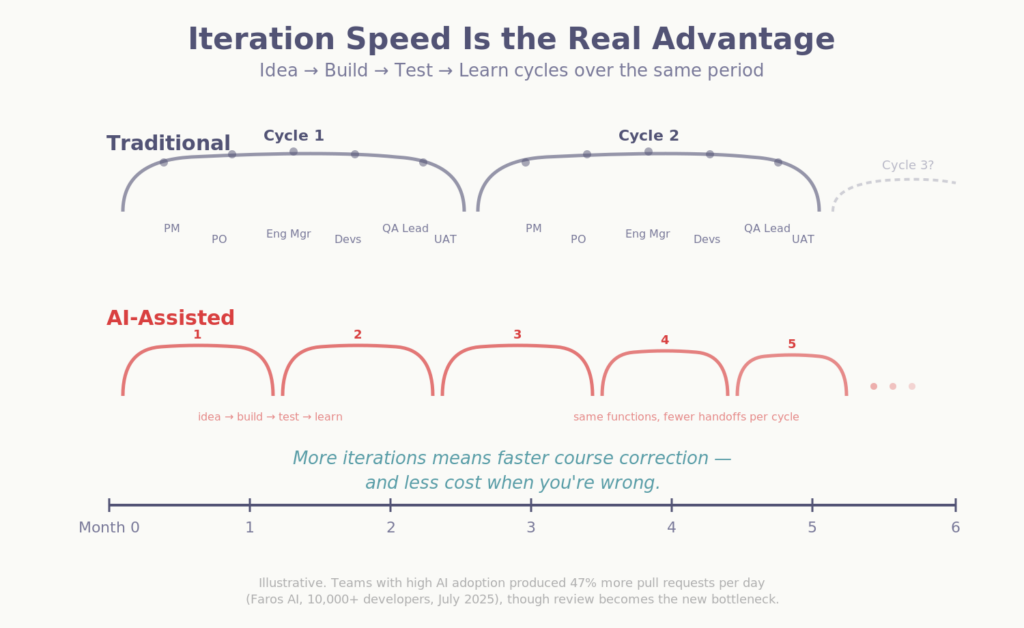
That exercise — resurfacing shelved initiatives and reassessing their feasibility — can materially change the ambition level of a value creation plan during a hold period. It’s not about making the existing plan cheaper. It’s about expanding what the plan includes.
The question isn’t whether to deploy AI — it’s whether you’re aiming high enough
Generative AI in private equity isn’t just an efficiency play. It’s an ambition multiplier. Firms that treat it as a cost-reduction tool will capture some value. The firms that treat it as a way to expand the portfolio of feasible initiatives — to move projects from “someday” to “this quarter” — will capture materially more.
The real question isn’t whether your portfolio companies are using AI. It’s whether they have the business clarity and judgment to deploy it where it actually changes the investment outcome. “Hours saved” is a rounding error compared to initiatives unlocked.