
For two decades, offshoring has been the default playbook for reducing engineering costs. AI coding tools are changing the math — not by being marginally cheaper, but by eliminating the trade-offs that made offshoring necessary in the first place. Operating partners should pressure-test this assumption in every value-creation plan.
The offshore model was built on an acceptable set of trade-offs
For twenty years, the calculus on engineering resources has been straightforward. If you need to reduce development costs, you offshore. If you want to reduce coordination friction, you nearshore. The trade-offs are well understood.
Offshore (for US companies) — typically India, Eastern Europe, or Southeast Asia — offers deep cost savings, with mid-level developers averaging $25–40 per hour versus $120–250 in North America. But it comes with 10–13 hour time zone gaps, cultural and language friction, and coordination overhead that quietly erodes the savings. Nearshore — Latin America, parts of Canada — narrows the time zone gap but doesn’t deliver quite the same cost advantage.
Every PE operating partner knows this playbook. The global offshore software development market was valued at roughly $179 billion in 2025 and is growing at nearly 15% annually. It has worked — imperfectly but consistently enough to become default advice.
AI tools don’t just reduce cost — they remove the trade-off entirely
The traditional offshore value proposition required accepting friction in exchange for savings. AI coding tools collapse that trade-off. They produce working software around the clock, with no time zone gap, no language barrier, and no sprint planning across a 12-hour offset.
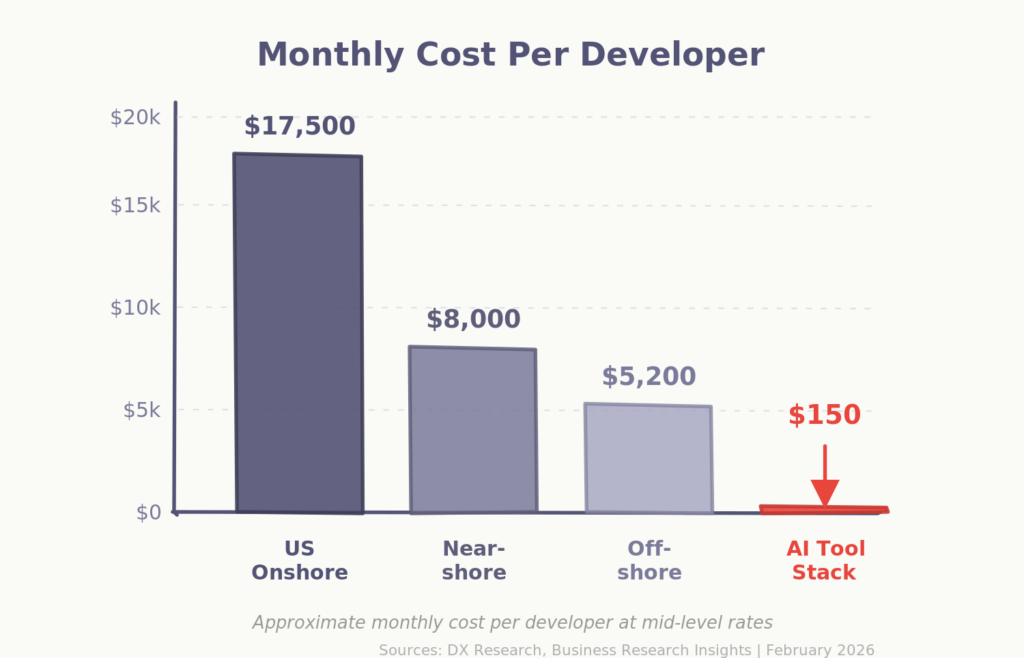
The cost profile is striking. A premium AI tool stack — GitHub Copilot, Cursor, Claude — runs $50–200 per developer per month. That’s not a different point on the same cost curve as offshore. It’s a fundamentally different category. Even a ten-person team fully equipped with premium AI tools costs less per month than a single offshore developer.
The productivity gains are real, but not universal
GitHub’s controlled study found developers completed a coding task 55.8% faster with Copilot — averaging 71 minutes versus 161 minutes for the control group. In enterprise settings, field experiments conducted by Microsoft and Accenture found more modest yet meaningful gains: 8–13% more pull requests per developer per week. Across 2025, median lines of code per developer grew from roughly 4,500 to 7,800 as AI tools matured.
But the nuance matters. A rigorous randomized controlled trial by METR found that experienced open-source developers were actually 19% slower when using AI tools on complex, familiar codebases — they overestimated AI’s value and lost time reviewing and correcting suggestions. The takeaway isn’t that AI tools don’t work. It’s that they work best for well-defined, modular tasks — precisely the type of work that gets offshored today — and less well for deep architectural work in codebases a developer already knows intimately.
The market is already signaling a structural shift
The trend lines suggest this isn’t speculative. Deloitte’s 2024 Global Outsourcing Survey found that cost reduction as the primary driver of outsourcing has dropped from 70% in 2020 to just 34% — companies increasingly cite access to specialized talent and customer demands as their top motivations. The cost lever alone no longer justifies the coordination overhead.
Gartner predicts that by 2027, agentic AI will reduce the cost-to-value gap on process-centric service contracts by at least 50%, replacing standardized workflows with context-driven orchestration. A February 2026 correction in Indian IT services stocks reflected the market beginning to price in this structural shift.
This isn’t about replacing people — it’s about changing the shape of the team
To be clear, I’m not suggesting offshore engineering is about to disappear. There are categories of work where human teams remain essential: complex system architecture, nuanced domain modeling, and long-term platform ownership. These require judgment, context, and continuity that AI tools don’t yet provide reliably. Offshore providers are also adapting — many are embedding AI directly into their delivery models.
And the risks of moving too aggressively are real. Forrester’s Predictions 2026 report found that 55% of companies that cut staff in favor of AI automation regretted the decision, noting that many firms chased AI-fueled efficiencies before understanding what AI could actually deliver. The lesson: augment thoughtfully rather than replace reflexively.
Not all offshore models carry the same switching cost
There’s an important distinction within offshore engineering that affects how readily a portfolio company can adapt. Companies using third-party vendors — Tata, Cognizant, Infosys, or smaller boutique shops — are typically working under service contracts with defined terms and exit clauses. Shifting that work to an AI-augmented domestic model is a vendor management decision. It’s not painless, but it’s structurally straightforward: you wind down the SOW as the contract allows and redirect the spend.
Captive offshore centers are a different matter entirely. A company with 200 employees in Bangalore or Kraków has real obligations — employment law, severance, institutional knowledge, and reputational considerations in markets where they may still need to hire. Unwinding a captive center is a multi-quarter initiative with HR, legal, and change management dimensions that extend well beyond engineering strategy.
For operating partners evaluating the AI-versus-offshore question, this distinction matters. The contractor model offers flexibility to experiment — you can pilot an AI-augmented approach on one workstream while maintaining the vendor relationship on others. A captive center requires a more deliberate transition plan, but may also be the higher-value target: the ongoing fixed cost of a captive operation is exactly the kind of structural expense that AI augmentation can help reduce over a hold period.
What doesn’t show up on the rate card often determines the real cost
Offshore engagements — whether vendor or captive — carry management overhead that’s easy to underestimate: vendor selection, contract negotiation, quality oversight, knowledge transfer, and the leadership attention required to keep distributed teams aligned. These costs don’t appear on a rate card, but they compound. During a PE hold period, where speed of execution directly impacts returns, that compounding matters.
An AI-augmented model doesn’t eliminate management complexity, but it changes its shape. Fewer vendors, faster feedback loops, and less dependency on time zone overlap. For a portfolio company with limited management bandwidth, that’s a material difference.
Before defaulting to the playbook, model the alternative
For firms and operators advising portfolio companies on engineering strategy, the practical step is straightforward: before defaulting to the traditional offshore playbook, model the alternative. A lean senior team, equipped with current AI tools, tackling the same scope. Compare not just the rate card, but the total cost — including time to delivery, rework, coordination drag, and management overhead.
The answer won’t always favor AI. Complex, long-running platform builds still benefit from dedicated human teams, and the METR findings remind us that AI augmentation has real limitations in certain contexts. But for the well-defined feature work, maintenance, and incremental builds that make up the bulk of what gets offshored, the economics are shifting fast.
The offshore equation was built for a world where cost and capability were geographically distributed. AI is collapsing that distribution. The firms that recognize this shift — and update their playbook accordingly — will have a meaningful edge.
Sources
- Business Research Insights — Offshore Software Development Market Size, 2025
- DX — AI Coding Assistant Pricing 2025
- Peng et al. — “The Impact of AI on Developer Productivity: Evidence from GitHub Copilot,” arXiv:2302.06590
- METR — “Measuring the Impact of Early-2025 AI on Experienced Open-Source Developer Productivity,” arXiv:2507.09089
- Deloitte — 2024 Global Outsourcing Survey
- Gartner — Strategic Predictions for 2026 and Beyond
- Forrester — Predictions 2026, via Computerworld